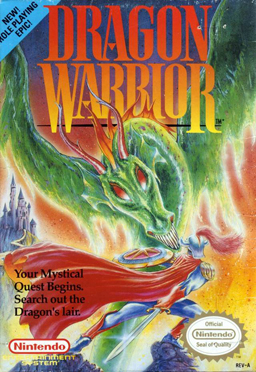
First Released: 1986
First Played: 1999
Recently Played: 2026
This is really the game that kind of started it all, for a lot of people. This review is going to be more of a retrospective and less of a review. The game stands the test of time, it is one of the most influential games I’ve ever played. As much jank as there is in an old RPG, especially one of the oldest console RPGs, it is so worth it and it has aged well. My most recent playthrough was on the HD2D edition of the game, but I have played many different versions of the game over the years, including my dad’s original cartridge.
This game had to trailblaze quite a bit of paths. This game is the creation of Yuji Horii, who attended AppleFest ’83 in San Francisco and came across the game Wizardry. He became fascinated by these “Western” RPGs such as Ultima, and would like to bring one of these Fantasy RPGs to a Japanese Audience. Horii brings in his friend to do the art, a little guy named Akira Toriyama.
Something that has always fascinated me when I play a game that came out before the PS2/GC generation, and that is the feeling that nobody even really knows what this “gaming” thing is. The way that the market moved, the way people would build consoles, and the decisions that go into development. For example, Horii chooses to build his game for the Famicom, and not an arcade system, because he didn’t want people to have to worry about putting in coins to continue.
All of this sounds kind of odd in retrospect, but it tells you where the games industry was. Most games were arcade like in nature. It’s difficult to get your parents to buy you a $50-$60 game in 1980s money (I assume). Replayability is a massive feature in every game. Due to this, it is also important that the game is a little confusing, because you probably won’t spend that money on a 6 hour adventure.
One of the elements that has aged this game the most is the fact that it is solo protagonist. If you’ve played it, you know why this can be an issue. You find yourself in a loop of getting hit and healing for quite some time of the game. This solo adventure actually wasn’t the intention, more of a factor of memory limit on older consoles. The absolute original version of the release on Famicom actually uses a password save system as well.
The version that we got over here in the states came out in 1989! A gap that was so long Dragon Quest 3 was released in Japan by the time it came out. There was a lot of hesitancy to port games like this over. For reference, the game sold nearly 1 million copies in a month in Japan, in America, it could barely crack 500,000, it was expecting millions. The game sold so poorly that they bundled it with Nintendo Power magazine subscriptions. Hard to imagine for such an important game that has ended up influencing so much. One critic even told people they should just skip it and pick up Ultima 3. When is the last time one of your friends talked about Ultima 3?
When we look at sales like this, it’s easy to see why so many RPGs didn’t start getting ported until significantly later. One of my fascinations as a kid was whenever a game would get ported over “for the first time”. I remember feeling like I was getting to really look at something special when I played Final Fantasy 3 on the DS. Most of the “great” games made the cut to get ported, but some of the really fun ones, like Final Fantasy 5, or Live a Live, didn’t make it over here until much later.
Dragon Quest 1 is a game that you definitely need to play. When you play it, you will feel every other RPG you’ve ever played represented in it. I don’t think it’s the best of the original console RPGs, but it is hard to state just how influential it was. Regardless of which version you play, it’s a short game.
 playoldgames
Leave a comment